What 'Senior' Actually Means in Product Design
The title says senior. The job description hasn't caught up. Here's what actually changes — in output, judgment, and mentoring — after fifteen years.
I've held the title "senior product designer" longer than I held "junior" and "mid-level" combined. The title hasn't changed once in fifteen years. The role underneath it has changed almost completely.
None of that shift shows up in a job description. It shows up in how problems get approached, what questions get asked before a single screen gets opened, and which battles are actually worth fighting.
The title says senior. It never explains what that means in practice. You have to work that out from what actually changes.
If you're wondering whether you've made that shift yet, or what to watch for as you do, here's what changed for me, in five specific ways.
Senior isn't a skill upgrade. It's a change in what you optimize for
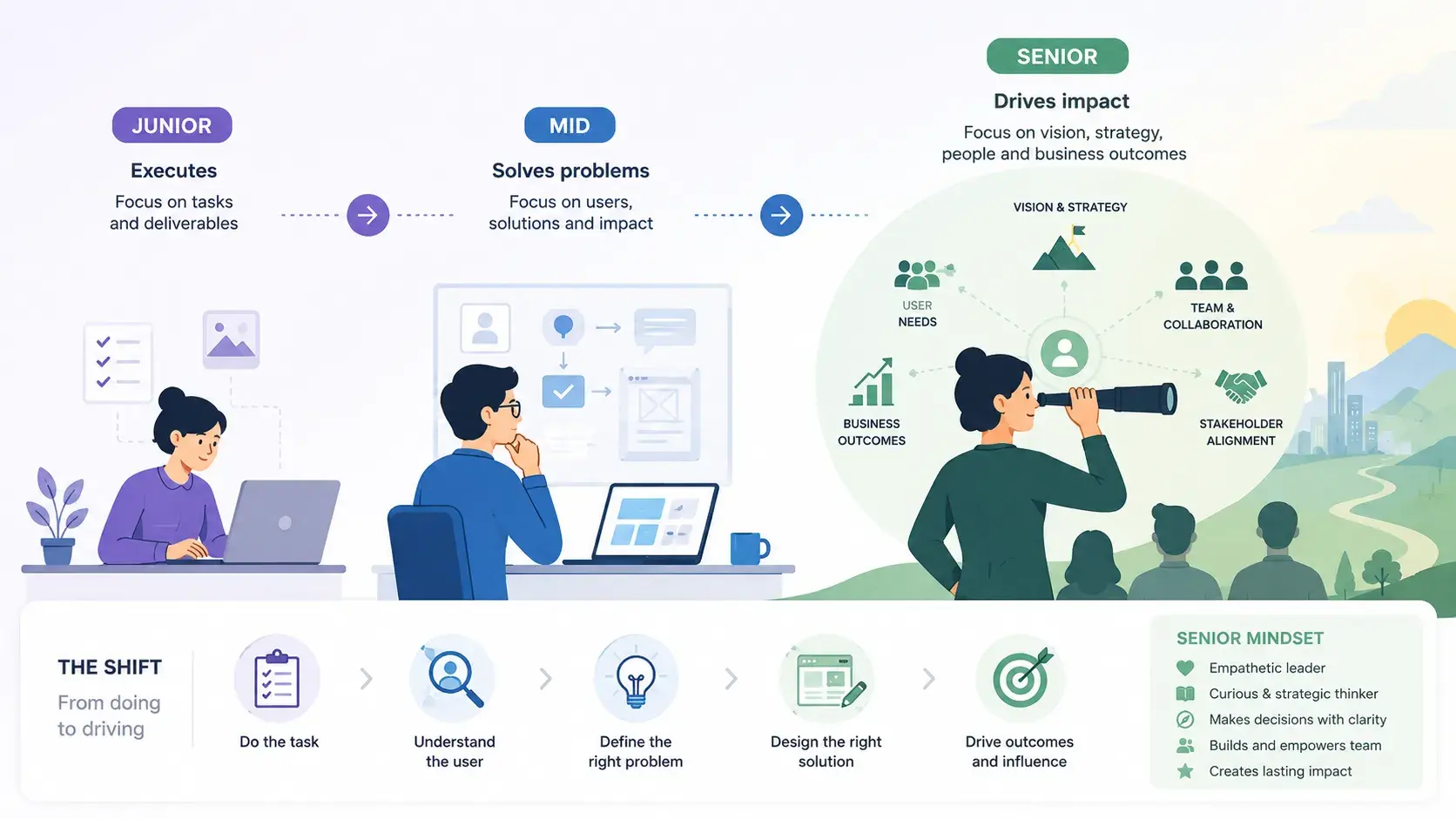
A junior or mid-level designer is judged on output: wireframes, prototypes, specs, polish. A senior designer is still judged on output, but the thing being optimized has moved up a level, from the artifact to the reasoning behind it.
| Focus area | Junior / mid-level designer | Senior designer |
|---|---|---|
| Primary output | Artifacts: wireframes, prototypes, specs | Clarity: on the problem, the tradeoffs, and the reasoning |
| How they advocate | For good design, in design language | For users, in the language the business already speaks |
| Main constraint | Craft and execution speed | Judgment: knowing which details are worth a fight |
| Relationship to the team | Produces work | Produces work and other designers' capability |
| Time horizon | This project | This project, and what the team can still do without you in five years |
That table is a simplification, and real careers are messier than any table. But it's the shift the rest of this article tries to unpack.
The output shifts: from artefacts to clarity
Junior designers produce artefacts. Wireframes, prototypes, specs. The work is tangible and easy to measure: you can hold it up and say, "here's what I made this sprint."
Senior designers still produce artefacts, but the primary output is clarity. Clarity on what problem you're actually solving. Clarity on why one approach beats another. Clarity on the tradeoffs between constraints that are all, individually, reasonable. The artefacts exist in service of that clarity. They stop being the point on their own.
This is a genuinely hard transition, because artefacts are what get praised in portfolio reviews. "Beautiful work." "Clean layouts." The clarity work is invisible right up until it's missing, and then everyone notices at once, usually in the form of a project that shipped the wrong thing beautifully.
The conversation changes: design fluency stops being enough
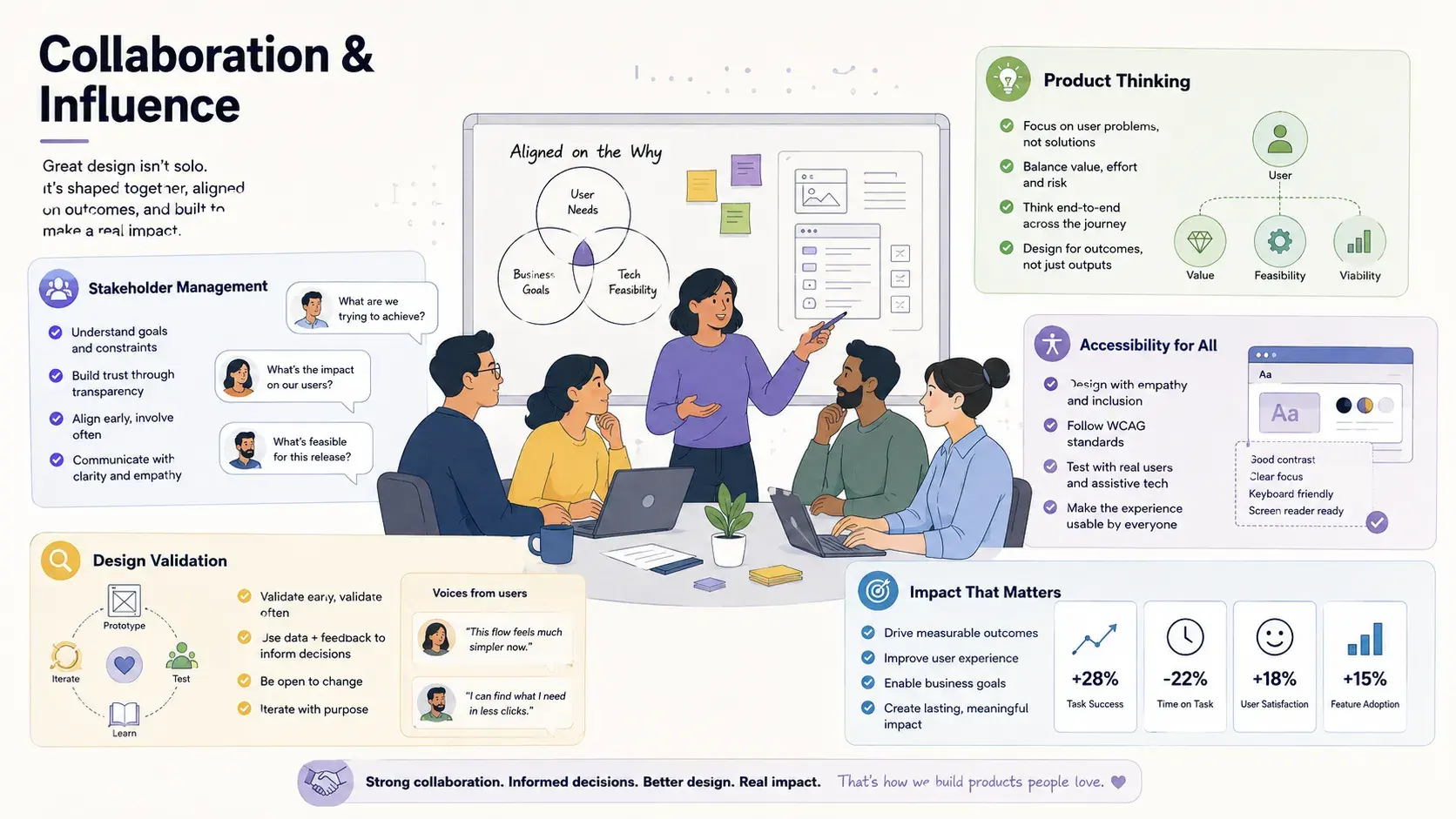
A junior designer advocates for good design. A senior designer advocates for users, inside the language the business already speaks.
That sounds cynical. It isn't. It's just accurate. In any product organization, design competes for resources and attention with engineering, sales, legal, and marketing. If you only speak design language, only designers will hear you.
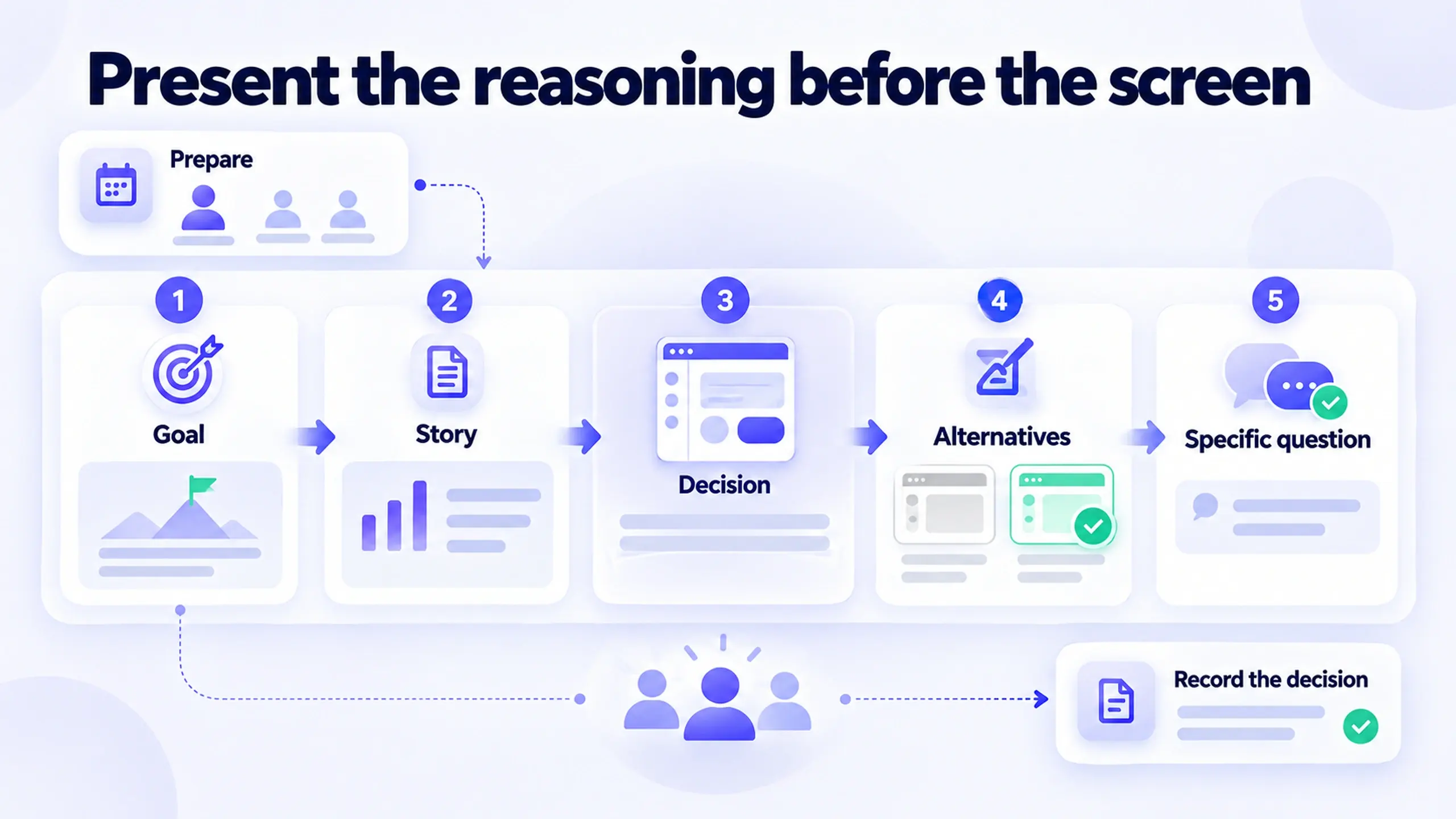
When I present research findings now, I translate them into business risk before I present a single screen. "Users abandon at this step" becomes "we're losing roughly X% of potential conversions at this point, which is worth approximately Y in annual revenue." Same finding. Different frame. Entirely different conversation on the other side of the table. NN/g's own research on quantifying usability work makes the same case from the other direction: framing usability findings in terms a business already tracks is what gets them acted on, not just acknowledged.
Translating a finding into business language doesn't weaken it. It's the difference between a finding that gets nodded at and one that changes a roadmap.
The hardest skill: knowing when to push and when to concede
The hardest skill I've developed in fifteen years isn't a design skill at all. It's knowing when to push and when to let something go.
Not every battle is worth fighting. Some design compromises are genuinely painful but not harmful. Others are genuinely harmful and need a champion. Telling the two apart takes judgment, and judgment only comes from watching the consequences of past decisions play out over time, including the times you were wrong.
The designers I admire most aren't the ones who fight for every pixel. They're the ones who:
- Have a clear hierarchy of what can bend and what can't, before the conversation starts, not mid-argument
- Fight hard for the things that affect users, not for their own aesthetic preferences
- Concede visibly and quickly on the compromises that are painful but not harmful, so their credibility is intact for the ones that matter
- Explain the "why" behind a concession, so the team doesn't mistake it for indifference
That list looks tidy in writing. In practice, getting it wrong (fighting the wrong battle, or folding on the wrong one) is how a lot of senior designers lose the room's trust, one small misjudgment at a time.
On mentoring: teaching is where your intuition gets tested
Senior designers grow by teaching. That sounds like advice aimed at whoever's junior on the team. It isn't. It's advice for you.
Teaching forces you to articulate things you currently do on intuition. Why did you structure that information architecture that way? Why is that button placement actually wrong, and not just different from what you'd have done? The intuition is usually correct. But putting the reasoning into words is how you test it, and it's how you occasionally discover that what felt like expertise was actually just habit.
The best feedback I ever gave a junior designer was the feedback that made me realize, mid-sentence, that I didn't fully understand my own reasoning yet. That's not a failure of mentoring. It's the mechanism working as intended.
The fifteen-year view: what compounds and what doesn't
What I know now that I didn't know at five years in: design is a long game. Careers are long. Industries change. The tools I used when I started don't exist in the same form anymore. The tools I use today won't look the same in ten years either.
The durable skills were never the tools. They're these four things:
- Asking the right questions before starting, not after the first draft is already built
- Listening carefully to the people who actually use what you design, not just the stakeholders in the room
- Making decisions from evidence rather than opinion, including your own opinion
- Communicating clearly across the full range of people who shape a product, from engineers to executives to support teams
Those four compound. Every tool, framework, and interface trend around them is replaceable, and most of what a five-year-in designer worries about turns out to be exactly that: replaceable. If you want a broader map of how a design career tends to unfold beyond this one shift, NN/G's overview of UX career progression is a useful outside reference point, not a rulebook.
Where this framing doesn't hold up everywhere
None of the above is universal, and it's worth saying plainly where it breaks down.
"Senior" means different things at different companies. Some organizations tie the title to years of tenure. Others tie it to a genuine shift in scope and judgment, the kind described here. A senior title at a five-person startup and a senior title at a thousand-person enterprise can describe meaningfully different jobs, even when the words on the offer letter match.
This is written from an individual-contributor track, not a management one. If your "senior" path leads toward managing other designers rather than deepening your own judgment, some of this still applies (especially the mentoring and communication sections), but the shift looks different in shape and speed.
None of this happens on a fixed timeline. Fifteen years is my own timeline, not a benchmark. Some designers make this shift faster with the right team and the right feedback loops; others hold a senior title for years without the underlying shift happening at all, usually because nobody around them modeled it.
Frequently asked questions
How do I know if I've actually made this shift, rather than just holding the title? Look at what you're being asked in meetings. If people mainly ask you how to build something, you're likely still in an execution-focused role. If people increasingly ask you whether something should be built, or why it should be built this way over another way, that's a signal the shift has already started, whatever your title says.
Does "senior" mean the same thing at every company? No, and this is worth confirming before you compare titles across companies or negotiate a move. Ask what a senior designer is expected to own, decide, and be accountable for at that specific company, not just what the title implies.
Do senior designers still do hands-on design work? Often, yes, especially on smaller teams. The shift described here is about what gets optimized for, not a step away from craft entirely. Plenty of senior designers still wireframe and prototype; they just spend more of their time on the judgment calls that shape what gets built in the first place.
What if I have the title but don't feel like I've made the shift yet? That's more common than it looks from the outside, and it's not a personal failing. Titles get awarded for reasons that include tenure, market conditions, and internal leveling politics, not only readiness. Treat the sections above as a working checklist rather than a diagnosis, and look for a mentor or manager who can give you the kind of direct feedback this article describes rather than trying to self-assess in a vacuum.
Update (September 2026): AI raised the floor on artefacts, not the ceiling on judgment
When I first wrote this, "junior output" mostly meant wireframes, specs, and prototypes built by hand. Now a junior designer, or a PM, or an AI tool on its own, can generate a plausible-looking flow in minutes. The artefact-versus-clarity gap this article describes didn't close because of that. It got wider.
An AI-generated screen can look finished without anyone having decided what problem it solves, what tradeoff it's making, or why this approach beats the three alternatives nobody looked at. That's exactly the judgment layer this article calls the senior shift, and it's now the part that's hardest to fake and easiest to skip. Faster artefacts didn't reduce the need for someone who can explain why the artefact is right. It made that person more load-bearing, not less.
If you're early in your career and everything you produce can now be generated in a prompt, the differentiator was never going to be the artefact. It was always going to be whether you can articulate why it's the right one.
Start with the shift, not the title
The title "senior" tells you almost nothing on its own. What tells you something is whether your output has shifted toward clarity, whether you can translate design judgment into language the business already trusts, whether you know which battles deserve your credibility, and whether teaching has started sharpening your own thinking rather than just passing it along.
Those shifts compound over a career the same way clear, written-down reasoning compounds for a team: the value shows up later, and it's invisible right up until it's missing.
This post was edited with AI assistance for clarity and formatting.

Sanjay Shrestha
Senior Product Designer · CUA™ Certified
15+ years designing enterprise SaaS, B2B, and government digital products. Currently at Decisions.
Keep Reading