Collaboration and Influence: 5 Skills That Get Design Decisions Shipped
Great designers create outcomes, not just artifacts. The skills that turn design thinking into shipped decisions — stakeholder management, validation, impact.
This is the final part of a practical series that explores the concepts, frameworks, and decision-making behind great digital products. Each article goes beyond definitions to explain when these concepts matter, why they matter, and how experienced product designers apply them in real-world work. Part 1: User Research · Part 2: Product Thinking · Part 3: Design Process · Part 4: Design Systems
The first four parts of this series were about how you think. This one is about how you operate.
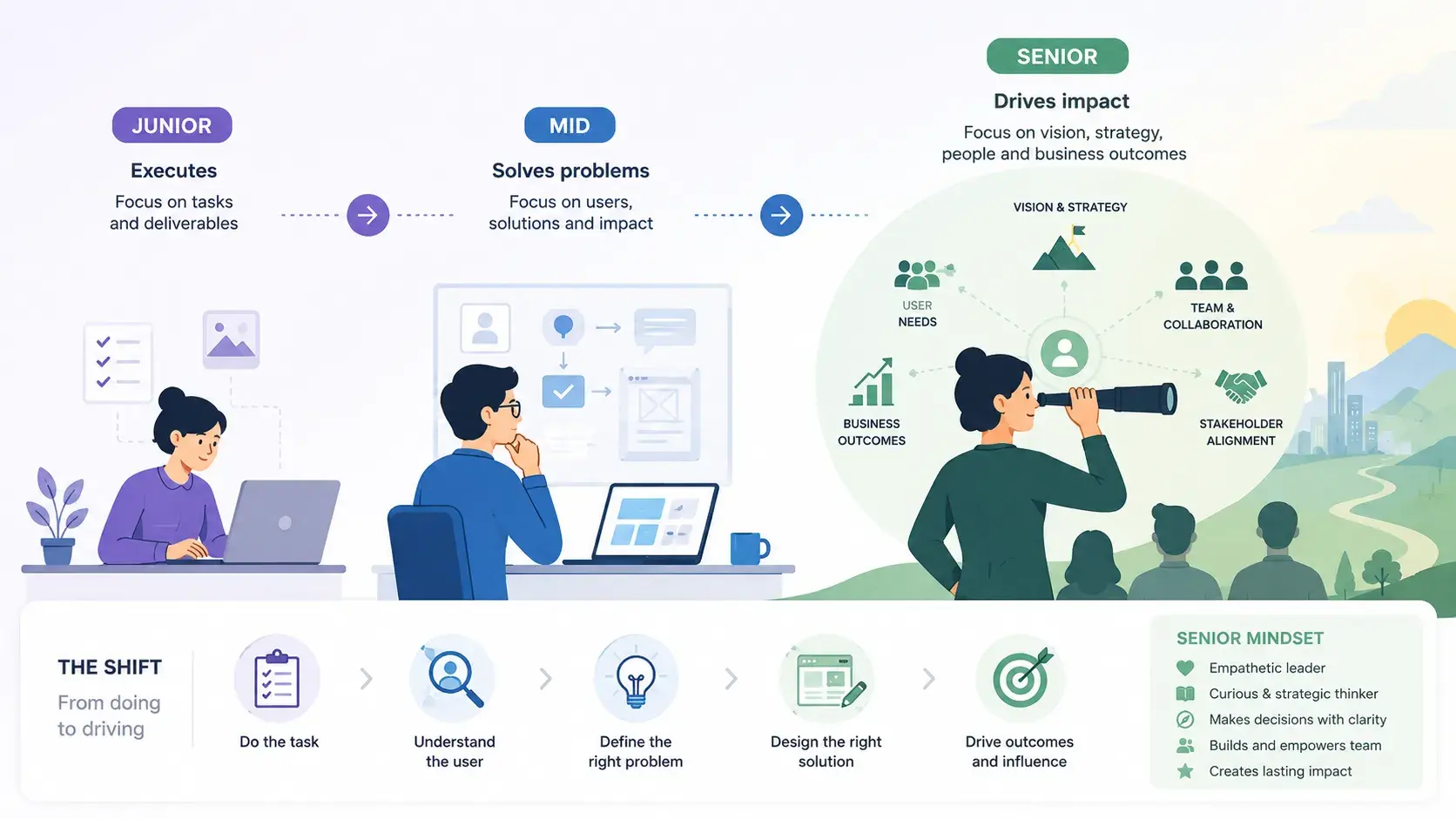
Great product designers don't just design well. They move work forward in organisations where priorities conflict, information is incomplete, and the people with the most power are often the furthest from the user. Collaboration and influence aren't soft skills. They're the ones that determine whether your best design thinking ever ships.
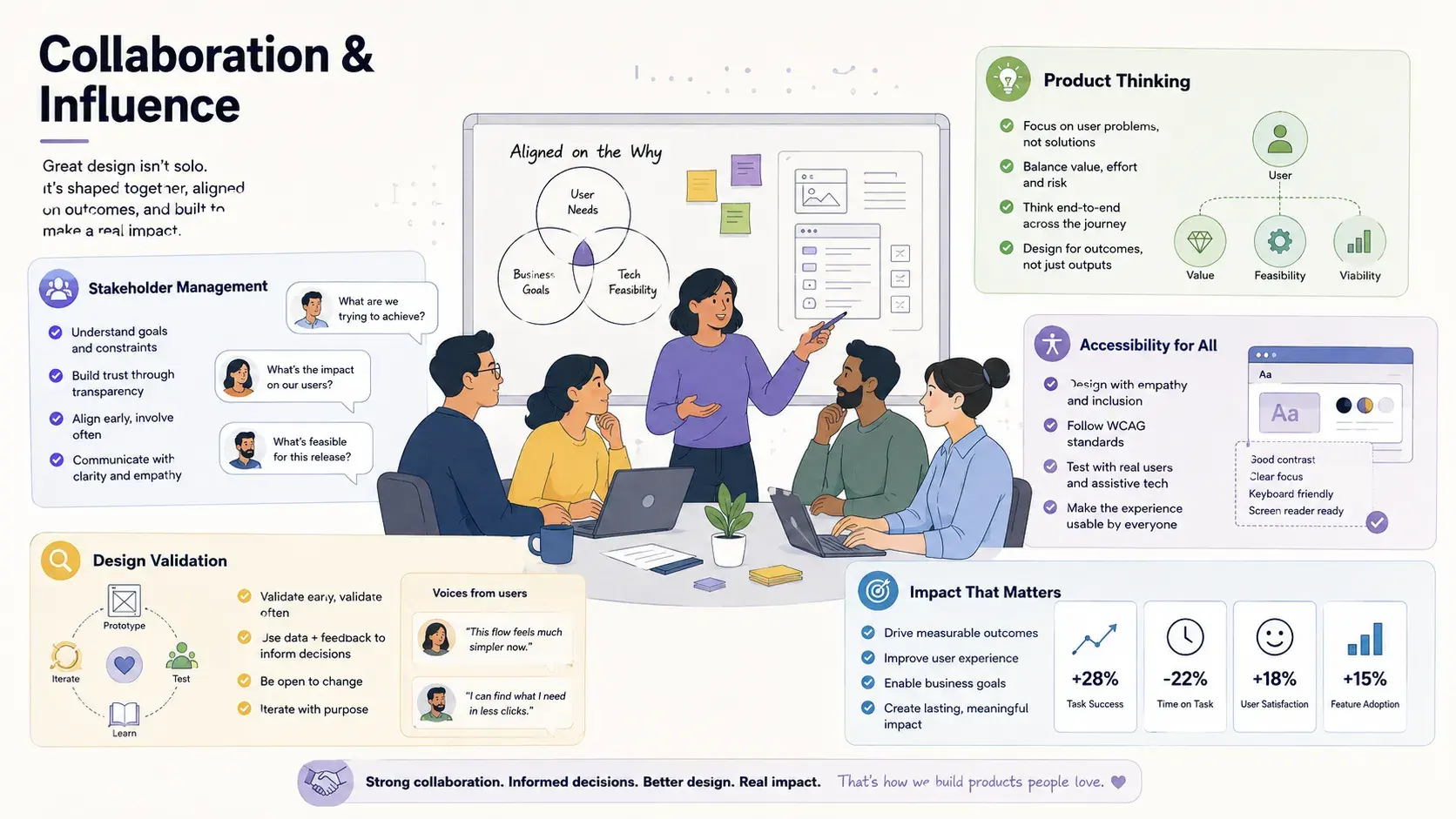
Stakeholder Management: Balancing Different Priorities
What most people say: "Working with different stakeholders to align on design decisions."
What shows experience: Stakeholder management isn't about making everyone happy. It's about making sure the right constraints are visible at the right time, to the right people. Happy stakeholders who haven't understood the trade-offs are a problem deferred, not solved.
The common failure: treating all stakeholders as equal. They're not. Experienced designers map stakeholders across three dimensions, a practice UX research calls stakeholder analysis:
- Decision authority: who can actually say yes or no
- Information quality: who has the most accurate picture of the problem
- Incentive alignment: whose goals overlap with user outcomes, and whose don't
The stakeholder who shouts loudest in a meeting is rarely the one whose opinion should carry most weight.
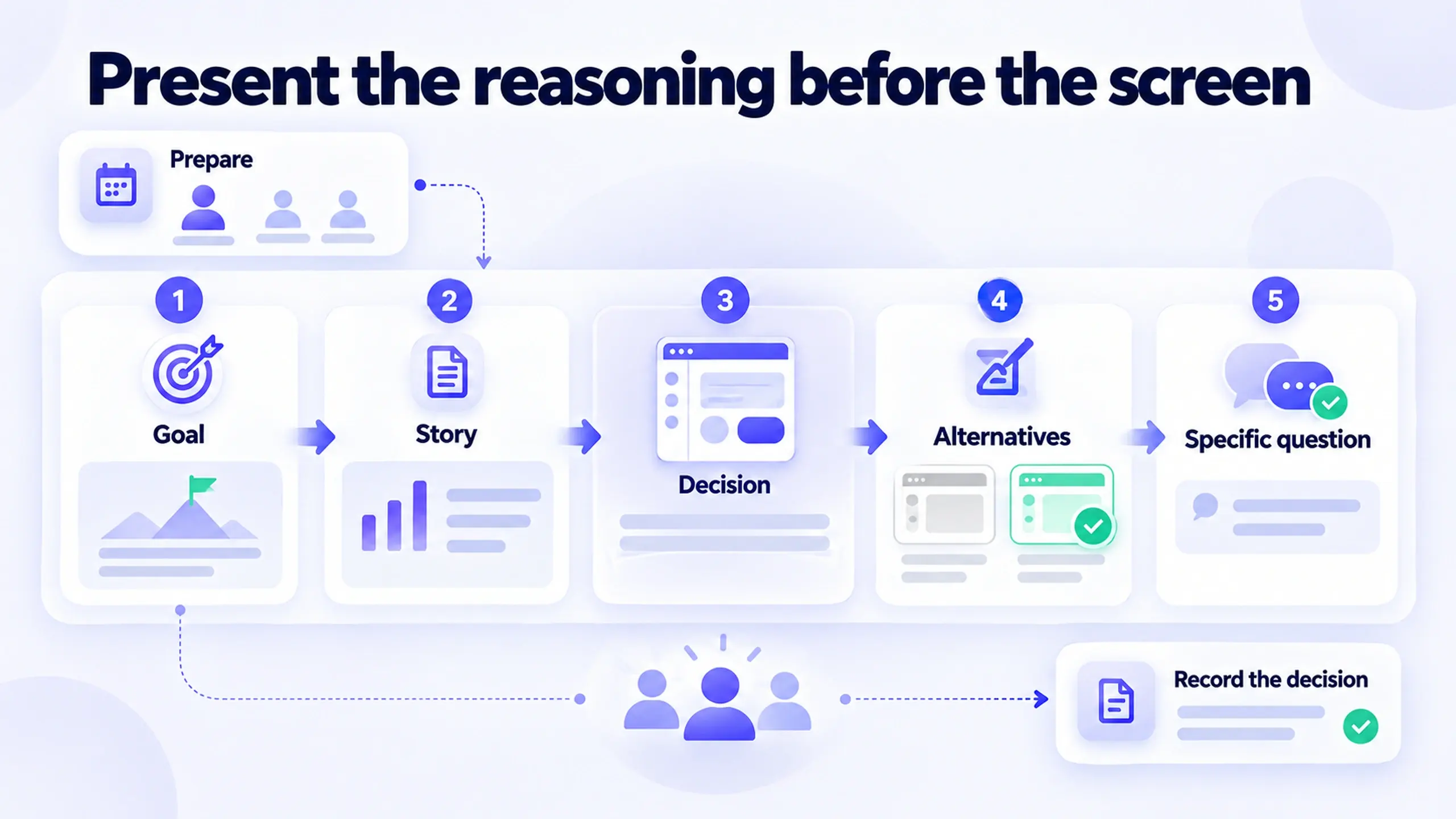
On a healthcare portal redesign, the marketing director wanted prominent brand imagery on the patient dashboard. The clinical team wanted clean data visibility. Both had valid arguments. The resolution wasn't compromise. It was evidence. We ran a preference test with 20 patients. Twelve chose the data-first layout. Four chose the brand-forward layout. Four were indifferent. We presented the finding, not an opinion. The marketing director changed their position based on data, not persuasion.
Where this shows up: naming the stakeholder conflict early, identifying what evidence would actually resolve it, and keeping the user's needs centred without dismissing legitimate business concerns. A preference-test result only changes minds if it's written down somewhere the whole team can find it later.
Product Thinking: Connecting Design Decisions to Business Goals
What most people say: "Understanding how design contributes to business outcomes."
What shows experience: Product thinking at the collaboration level means being able to speak the language of the people you're working with, and that language is outcomes, not outputs.
When a PM says "we need to increase activation," the wrong response is showing a new onboarding screen. The right response is asking: "What's our current activation rate, where's the drop-off, and what do we know about why?" Then designing from the answer.
The frames that make design decisions legible to non-designers:
- "This decision affects X metric because…" connects craft to measurement
- "The risk of not doing this is…" makes the cost of inaction visible
- "Here's what we'd need to believe for this to work…" surfaces assumptions before they become expensive
On a dashboard redesign, the exec sponsor wanted to add four new data widgets before launch. I built a simple one-pager: current page load time (3.2s), projected load time with four new widgets (5.8s), and research showing each additional second of load time reduced engagement by 11% in B2B SaaS. The widgets weren't added. Not because design said no, but because the trade-off was now legible to someone who cared about engagement, not load time.
Where this shows up: a design decision made legible to a non-designer, a clear frame that connects the trade-off to something they already care about, and a decision that changes as a result.
Accessibility: Designing Products Everyone Can Use
What most people say: "Following WCAG guidelines to make products usable by people with disabilities."
What shows experience: Accessibility is not a checklist run at the end of a project. It's a design constraint that shapes decisions from the beginning. Teams that treat it as a final audit always find issues too late to fix without significant rework.
The practical shift: stop thinking about accessibility as a disability issue and start thinking about it as a design quality issue. Sufficient colour contrast helps users in bright sunlight. Keyboard navigation helps power users. Clear focus states help anyone filling out a long form. These improvements benefit everyone.
What senior accessibility practice looks like:
- Colour decisions made with contrast ratio in view, not checked afterward
- Interactive elements designed with keyboard and screen reader in mind from wireframe stage
- Error messages that tell users what to do, not just what went wrong
- Motion that respects
prefers-reduced-motion: not as an edge case, as a requirement
Accessibility debt is the most expensive kind. Retrofitting it costs far more than building it in from the start.
On a government service, we were told accessibility was "nice to have" and deprioritised for v1. During a legal review three months post-launch, the product was flagged as non-compliant with public sector accessibility requirements. The retrofit took six weeks and delayed two planned features. Every accessibility decision that seemed "extra" at the start would have cost one hour during design. It cost forty hours during rework.
Where this shows up: an accessibility decision made proactively at the wireframe stage, a compliance issue caught before launch, or accessibility built into a team's workflow rather than treated as a separate phase.
Design Validation: Proving Your Solution Solves the Problem
What most people say: "Testing your design to make sure it works."
What shows experience: Validation is the gap between confidence and certainty. Every designer is confident their solution will work, otherwise they wouldn't ship it. Validation is the discipline of checking that confidence against reality before the cost of being wrong becomes too high.
The forms of validation, matched to what they're actually good for:
| Method | Best for | Watch out for |
|---|---|---|
| Prototype testing | Confirming the interaction works as intended | Tests usability, not whether people want the outcome |
| A/B testing | Comparing a new version against the current one, at scale | Needs an existing baseline and enough traffic to be conclusive |
| Fake door testing | Checking real demand before building anything | Measures interest, not whether the finished feature delivers value |
| Staged rollout | Confirming behaviour holds up with real users under real conditions | Only possible once the feature already exists |
The mistake most designers make: validating the solution instead of the assumption. If the assumption behind your solution is wrong, validating the solution doesn't help. The question isn't "did users complete this task?" It's "did completing this task produce the outcome we expected?"
A design can test well and still fail in production. Validate the assumption, not just the interface.
On a new feature for a project management tool, we prototype-tested with eight users. All eight could use it. We launched. Engagement was 12% of what was projected. Post-launch research revealed users understood the feature, they just didn't believe it would save them time versus their existing workaround. We'd validated usability. We hadn't validated value. We added a before/after time comparison to the feature's empty state. Engagement reached 61% of projection within four weeks.
Where this shows up: choosing a validation method deliberately, being honest about what it confirmed or disproved, and changing the design based on the evidence rather than the plan.
Impact: Demonstrating Measurable User or Business Outcomes
What most people say: "Showing that your design work made a difference."
What shows experience: Impact is the only thing that makes a design case credible to stakeholders who aren't designers. Beautiful screens say you have craft. Metrics say you have judgment.
The challenge: many designers work on products where they don't own the measurement, don't have access to data, or ship features into a roadmap where attribution is genuinely hard. That's real. But it's not an excuse for not having a number.
How to surface impact even when it's messy:
- Partial attribution is still attribution: "we shipped X, and Y metric moved; we believe the correlation is real because Z"
- Leading indicators count: task completion rate, error rate, and support ticket volume are measurable before business metrics move
- Qualitative impact is still impact: a quote from a user whose workflow you changed, a PM who said "this is the clearest handoff I've ever received"
"I don't have metrics" is almost never true. It usually means "I didn't ask for them."
On a redesigned onboarding flow, I didn't own the analytics dashboard. But I tracked: support tickets mentioning the onboarding steps I changed (down 43%), completion rate from the engineering team's logs (up 31%), and an NPS survey open comment that mentioned the new flow by name as a positive experience. None of those were perfect attribution. Together they were a credible story.
Where this shows up: a specific metric that moved because of a design decision, a clear account of how it was measured, and how the story was communicated to stakeholders. UX changes that measurably improved conversion is a good next read if this is the part of the job you want to get sharper at.
Frequently Asked Questions
Do I need formal authority to manage stakeholders well?
What if I don't own the metrics or analytics for my product?
Is accessibility really a UX issue, or is it a compliance issue?
How do I choose a validation method when I don't have much time?
The Full Picture
Across five posts and 25 concepts, there's one thread: the product designer who creates lasting impact is the one who can connect their decisions to outcomes, their process to evidence, and their craft to the people they're working with.
Not just what you designed. Why. Not just how it looked. What it changed.
That's product design work. That's also what makes it matter.
This completes the series. Across research, product thinking, design process, design systems, and collaboration, the throughline has been the same: great product design isn't a set of definitions to memorise, it's a set of judgment calls, made well, again and again, in the messy conditions of real work.
Part 5 of 5 · Product Design Concepts Explained
- 1User Research
- 2Product Thinking
- 3Design Process
- 4Design Systems
- Collaboration & Influencethis post
This post was edited with AI assistance for clarity and formatting.

Sanjay Shrestha
Senior Product Designer · CUA™ Certified
15+ years designing enterprise SaaS, B2B, and government digital products. Currently at Decisions.
Keep Reading