Product Thinking: 5 Concepts Every Product Designer Should Master
Great design goes beyond interfaces. Product thinking helps you define the right problems, measure success, and prioritize outcomes that matter.
This is Part 2 of a 5-part series that explores the concepts, frameworks, and decision-making behind great digital products. Each article goes beyond definitions to explain when these concepts matter, why they matter, and how experienced product designers apply them in real-world work. Part 1 covered User Research. This post covers product thinking.
There's a version of a designer who ships beautiful screens. And there's a version who changes what gets built in the first place.
Great product designers, especially at product-led companies, learn to operate as the second kind. Product thinking isn't a separate skill from design. It's the lens that makes your design decisions legible to the business, and it's what makes you someone worth including in early conversations, not just the person who receives the brief once the decisions are already made.
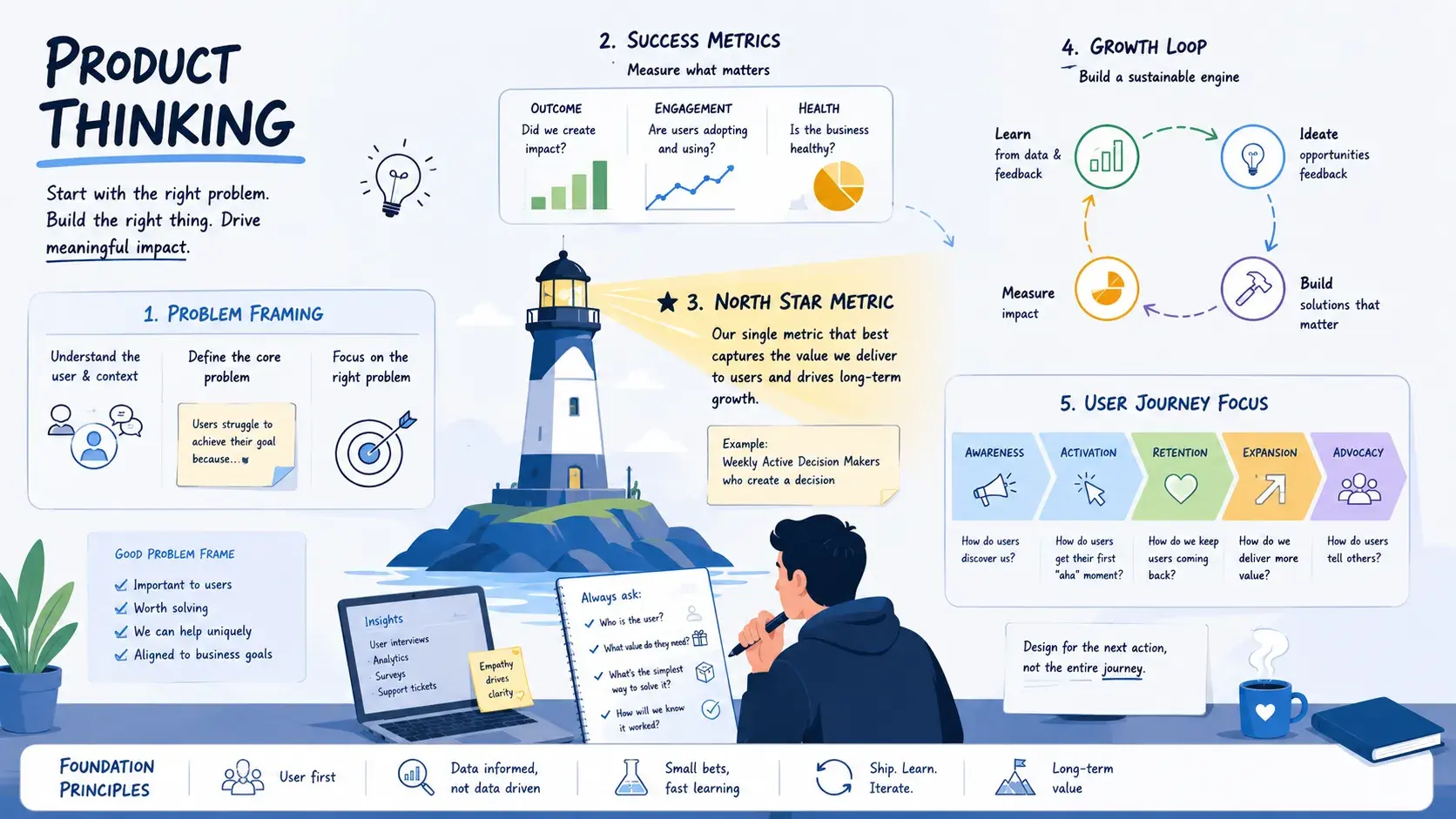
Five concepts show what that looks like in practice: problem framing, success metrics, the North Star Metric, activation, and retention.
The Five Concepts at a Glance
| Concept | What most people do | What shows experience |
|---|---|---|
| Problem framing | Accept the brief as written | Pressure-test the brief before committing weeks to it |
| Success metrics | Track whatever the company already measures | Pick a metric sensitive to this change, plus a counter-metric |
| North Star Metric | Treat it as a dashboard number | Use it to force alignment when teams disagree on direction |
| Activation | Define it vaguely ("completes onboarding") | Define the exact behavior that predicts retention |
| Retention | Reach for a growth tactic or dark pattern | Diagnose the root cause inside the core product loop |
Treat this table as the fifteen-second version. The sections below are the one worth reading properly, because the "what shows experience" column only means something once you've seen it applied.
Problem Framing: Defining the Right Problem Before Solving It
What most people say: "It's about understanding the problem space before jumping to solutions."
What shows experience: Problem framing is the skill of refusing the brief long enough to ask whether it's the right brief. Most design problems arrive pre-framed. Someone has already decided what the problem is. Your job is to pressure-test that framing before investing weeks into solving the wrong thing.
The classic failure mode: a stakeholder says "users need a better onboarding flow." A designer builds a better onboarding flow. Retention doesn't move. The post-mortem reveals the real problem was that users didn't understand the product's value proposition, and that problem lives in marketing, not onboarding.
The brief is a hypothesis, not a directive. Treat it like one.
On a government portal project, the stated problem was "the form is too long and users drop off." We reframed it after two days of research: users weren't dropping off because the form was long. They were dropping off because they didn't know what documents they'd need before they started. The fix wasn't a shorter form. It was a requirements checklist on the landing page, built in a day, that reduced drop-off by 34%.
Where this shows up: during product discovery, this looks like pushing back on a problem definition before committing engineering time to it, being explicit about what evidence you used to reframe the problem, and tracking what changed as a result.
Success Metrics: Measuring Whether a Solution Actually Worked
What most people say: "KPIs that tell you if the design is performing."
What shows experience: Most designers can name metrics. Fewer can define them before the work starts, and fewer still can explain why a metric moved, or didn't, after launch.
The discipline is in choosing metrics that are sensitive to your specific design change, not just the metrics your company already tracks. If you changed a checkout flow, "revenue" is too blunt an instrument. "Checkout completion rate by step" is the right one.
Three questions worth asking before any project starts:
- What does success look like in 30 days? This forces specificity instead of a vague sense of "better."
- What's the counter-metric? Every optimization has a tradeoff. If click-through goes up, does satisfaction go down? Guardrail and counter-metrics exist precisely to catch that kind of silent tradeoff before it compounds.
- What would make us roll this back? Defining failure criteria upfront is more useful than defining success. It forces you to name, in advance, exactly what evidence would change your mind.
On a feature I shipped for an enterprise workflow tool, we tracked task completion rate as our primary metric. It improved. But our counter-metric, time-to-complete, went up, which told us users were finishing tasks but doing more work to do so. We'd moved load from one step to another. We wouldn't have caught that without the counter-metric.
In real product work: this means defining a specific metric before a project starts, being ready to explain what you learned once you measured it, and treating any surprise the data reveals as a signal worth investigating rather than noise.
North Star Metric: The Metric That Best Reflects Product Value
What most people say: "The single metric that represents the core value of your product."
What shows experience: A North Star Metric is a forcing function for alignment, not just a dashboard number. Its value isn't measurement. It's the conversation it forces when teams disagree about direction, and Amplitude's own North Star framework makes the same case: the metric matters less on its own than as the shared reference point a team argues in front of.
Three common mistakes worth naming:
- Revenue as North Star. Too downstream, too many variables, too slow to respond to any single design decision.
- DAU/MAU. Measures presence, not value. Users who log in and immediately leave still count.
- NPS. A lagging indicator. By the time it moves, the damage is already done.
A good North Star Metric moves when users get value. Not when they show up. Not when they pay. When they succeed.
For a meeting productivity tool I worked on, the candidate metrics were: monthly active users, meeting count, and "meetings where action items were completed within 48 hours." Only the third one tracked whether the product actually worked. It was harder to measure. It was the right one.
Where this shows up: when building successful products, this means being able to name the metric you'd choose as a product's North Star, articulate why the alternatives fall short, and use that metric to force alignment when a team disagrees about direction. That's also where translating a design decision into language the business already speaks tends to matter most, since a North Star Metric only works as alignment if the room actually understands why you picked it.
Activation: The Moment Users First Experience Value
What most people say: "When a user first gets value from the product."
What shows experience: Activation is the most underinvested moment in most products. Companies spend heavily on acquisition and retention, then wonder why both leak. Activation is the seam between the two, and it's almost always a design problem.
The activation moment is specific. It's not "a user signs up." It's "a user completes their first project" or "a user sends their first message to a teammate" or "a user sees their first insight." Defining it precisely is what makes it improvable.
- Vague: "User completes onboarding."
- Specific: "User publishes their first piece of content within 7 days of signup."
This is the same instinct behind Superhuman's well-documented approach to finding product-market fit: a vague sense that people "like the product" is useless. A precisely defined behavior you can measure and design toward is the whole game.
On a SaaS analytics product, activation was originally defined as "user views a dashboard." Post-analysis showed users who viewed and filtered a dashboard within 72 hours retained at three times the rate of those who only viewed. The filtering behavior was the real activation event. We redesigned onboarding to guide users to their first filter, not just their first view. Activation-to-retention conversion improved by 28%.
In real product work: this means defining an activation moment specifically, rather than settling for a vague proxy, and being able to point to the design change that improved it.
Retention: How Well Your Product Brings Users Back
What most people say: "Whether users keep coming back to use the product."
What shows experience: Retention isn't a metric you optimize at the end. It's a signal that tells you whether your core product loop is working. If you're losing users after their first or second session, no growth tactic fixes that. You have a product problem, not a marketing one.
The design-specific lens on retention is habit formation. Users return when the product fits into an existing behavior pattern, or creates a new one worth repeating. Nir Eyal's Hooked model, built from trigger, action, variable reward, and investment, describes exactly this loop, and it's a useful diagnostic even if you never build a feature around it deliberately: triggers, rewards, and value loops are a design problem before they're a growth one.
Retention problems are almost always core-value problems. Dark patterns delay the signal. They never fix the underlying issue.
On a productivity app, retention at week 4 was 18%, low for the category. Analysis showed users who set up a recurring reminder on day one retained at 61%. The reminder setup was buried in settings, three taps deep. Moving it to the end of the first-run flow, not as an option but as a step, lifted 4-week retention to 39% in an A/B test. Same core product, same value proposition. The design change simply surfaced the habit trigger earlier.
Where this shows up: throughout the design process, this means diagnosing retention problems down to their root cause, rather than reaching for a growth tactic, and knowing which design lever actually moves the underlying behavior.
Where Product Thinking Runs Into Limits
None of this works the same way in every context, and it's worth naming where the approach strains.
- Pressure-testing a brief takes time you don't always have. The government portal example took two days of research before the real problem surfaced. On a tight sprint deadline, that runway doesn't always exist, and shipping the imperfectly-framed version on time can genuinely beat shipping the perfectly-framed version late.
- A North Star Metric can be gamed if a team optimizes the number instead of the value behind it. "Meetings with action items completed within 48 hours" is only useful as long as nobody starts padding action-item counts to move the metric itself.
- Retention diagnosis assumes you have the data infrastructure to see the pattern. Spotting that reminder setup predicted 4-week retention required behavioral data most early-stage products simply haven't instrumented yet.
Frequently Asked Questions
Is product thinking the same as product management?
How do you push back on a brief without seeming difficult?
What if I don't have the data to define a counter-metric?
Does every project need its own North Star Metric?
The Thread That Connects All Five
Problem framing, success metrics, the North Star Metric, activation, and retention aren't five separate concepts. They're a single chain of reasoning:
Define the right problem → measure the right outcome → know what success looks like → design the moment value lands → make sure users return for it.
A designer who can walk through that chain for any project they've worked on isn't just a designer. They're a product partner. In real product teams, that's who earns a seat in early conversations, and who keeps it.
Try this on your next project
- Write down the brief as given, and one alternative framing worth testing before you commit to it
- Define your primary metric and its counter-metric before the project starts, not after
- Name the North Star Metric your work should move, and why the obvious alternatives (revenue, DAU/MAU, NPS) fall short here
- Define your activation moment as a specific, measurable behavior, not a milestone like "completes onboarding"
- If retention is low, look for the root habit or trigger problem before reaching for a growth tactic
Part 2 of 5 · Product Design Concepts Explained
This post was edited with AI assistance for clarity and formatting.

Sanjay Shrestha
Senior Product Designer · CUA™ Certified
15+ years designing enterprise SaaS, B2B, and government digital products. Currently at Decisions.
Keep Reading