Designing Trust Into AI Features: Why Explainability Beats Accuracy
Users don't trust AI because it's accurate. They trust it because they can see why it did what it did. A framework for designing calibrated trust into AI features.
This is Part 4 of The Product Designer's Playbook, a series working through the day-to-day craft of product design one topic at a time: UX laws, accessibility, stakeholder management, communication, career, components, and more. Part 3 covered color contrast, the 30-second check most screens skip. This piece is a full reference on designing trust into AI features, written so it works whether you're shipping your first AI feature or your tenth.
Accuracy and trust are not the same design problem, and treating them as one is why so many AI features underperform their own model quality. A feature can be right 95% of the time and still get ignored, overridden, or abandoned, because trust isn't a property of how often the AI is correct. It's a property of whether the user can tell when to rely on it and when not to.
That distinction has a name in the human-automation research this field draws on: calibrated trust, trust that tracks the system's actual reliability rather than over- or under-shooting it. A user who blindly trusts an accurate system is one bad output away from a bad outcome. A user who reflexively distrusts an accurate system just stopped using a feature that was working. Both are failures of the same design problem, and neither is fixed by making the model more accurate. Both are fixed by making the system's reasoning visible enough to calibrate against.
Why accuracy alone doesn't produce trust
An AI feature that gives no visibility into its own reasoning puts the user in an impossible position: accept the output on faith, or reject it on suspicion. Neither is a judgment call, because there's nothing to judge. Nielsen Norman Group's research on explainable AI puts the mechanism plainly: showing how a system reached an output helps people form accurate mental models of what it can and can't do, and helps them decide, case by case, whether to trust a specific result. Withhold that, and confident-sounding output doesn't make users more skeptical. It tends to make them less skeptical than the situation warrants, which is the opposite of what a probabilistic system deserves.
This is also why "just make the model better" doesn't close the trust gap on its own. A more accurate model with an opaque interface still leaves the user with a coin flip: trust this one or don't. Explainability is what turns that coin flip into an actual decision.
The three things trust is actually made of
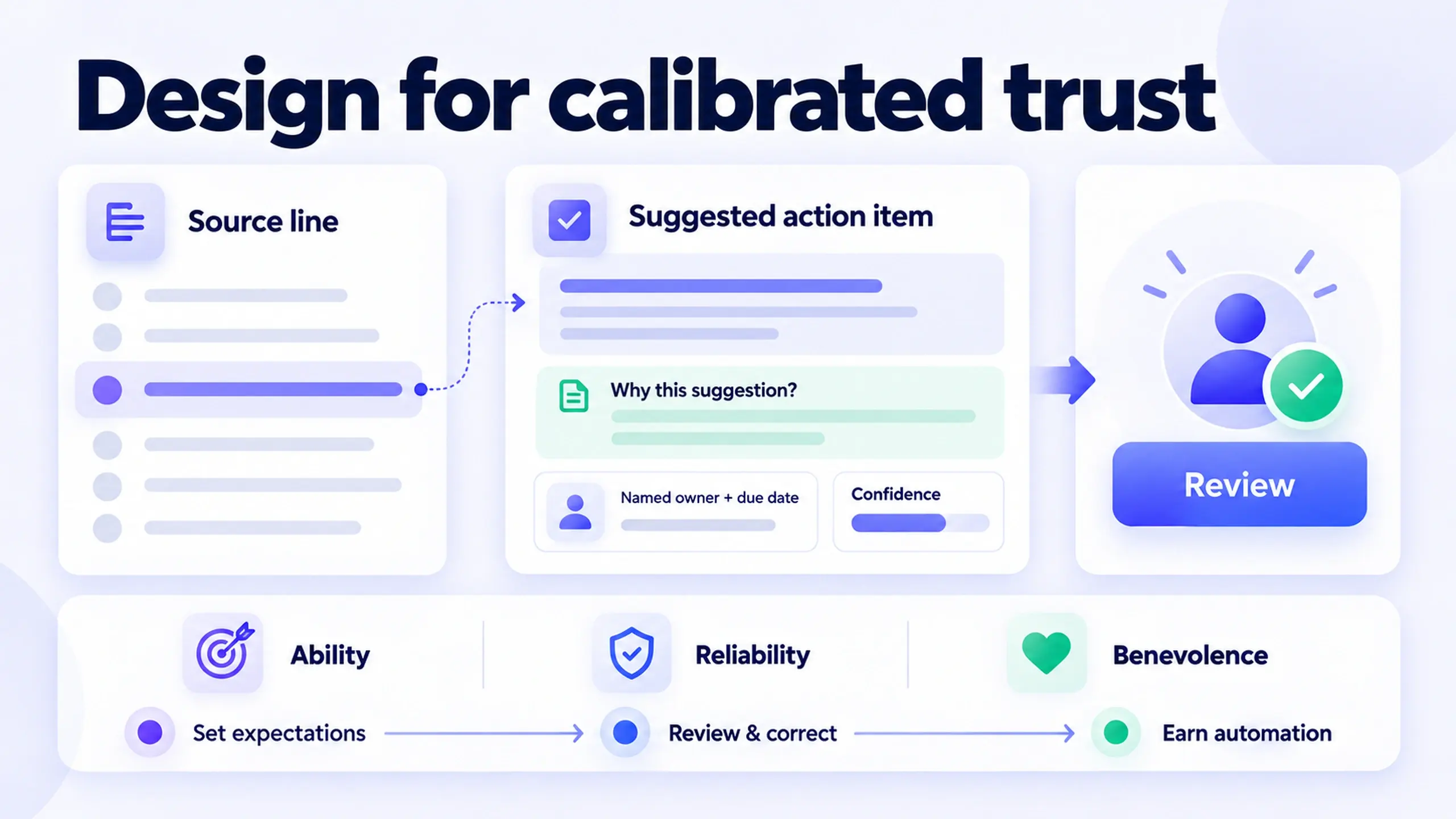
Google's People + AI Research (PAIR) guidebook breaks trust in an AI product into three distinct components, and treating them as one blurs where a feature is actually failing.
| Dimension | What it asks | Where it typically breaks |
|---|---|---|
| Ability | Does this actually address what I need? | The feature is well-designed but solves the wrong problem, or solves it for the wrong workflow |
| Reliability | Does it keep delivering what it promised, consistently? | Performance is inconsistent across cases the user can't predict or explain |
| Benevolence | Is this built to help me, or to serve someone else's interest? | The feature optimizes for engagement, upsell, or the vendor's metrics in ways the user can sense but not always name |
Ability and reliability are the ones most teams design for. Benevolence is the one most teams forget to design for at all, and it's often the actual reason a technically excellent AI feature still feels untrustworthy: users can tell, even without articulating it, when a suggestion seems to serve the product's goals more than their own.
Not every explanation needs to be the same depth
Explaining an AI decision doesn't mean surfacing a debug log. PAIR's framework distinguishes a few practical explanation types, and matching the type to the moment matters more than maximizing detail.
- Partial explanations. Surface the two or three factors that actually drove the output, and leave out what's genuinely too complex or unknowable to state simply. A partial, honest explanation beats a complete, unreadable one.
- General system explanations. A brief, standing description of what the feature does and doesn't do, set early, so the user has a baseline before they see their first output.
- Specific output explanations. Why this suggestion, right now. This is the one users actually ask for in the moment ("why did it flag this as urgent?") and the one most interfaces skip.
- Confidence displays. A categorical label, a percentage, or a set of alternatives, shown at the moment of output, not buried in settings.
In practice: match the depth to the stakes, not to what's easiest to build. A routine, low-consequence suggestion needs a partial explanation at most. A suggestion that changes what a team decides or commits to needs a specific-output explanation, every time.
Trust gets built in stages, not shipped in one release
Trust in an AI feature isn't a fixed property of the release. It's built across three distinct moments, and skipping one usually shows up as a support ticket later, not a launch-day bug.
- Onboarding. Set realistic expectations about what the feature can and can't do before the user sees their first real output. A feature introduced as "it'll handle this for you" sets a different bar than one introduced as "it'll draft a starting point for you to check."
- Early usage. Give users a low-commitment way to see the system work and correct it when it's wrong. This is also where the system should be learning from the user, not just the reverse: preferences and corrections should visibly shape what it does next.
- Ongoing use. Automation can reasonably increase as trust is demonstrated, not assumed. Permissions and what the AI is allowed to do on its own should stay visible and adjustable, and when something does go wrong, there needs to already be a recovery path, not one improvised after the fact.
Calibrated trust isn't something you design once at launch. It's something the product has to keep earning, in stages, every time the AI is visibly right or wrong.
A worked example: the same suggestion, two levels of visibility
The following is a simplified, hypothetical example meant to illustrate the difference, not a documented case study.
Picture a feature that flags a line from a meeting transcript as a likely action item.
Weak version: the item appears in a list with a small "AI-generated" badge. No indication of why this line, out of the whole transcript, was the one flagged. The user either accepts the badge's authority or ignores the whole list.
Improved version: the flagged item shows the source line it was pulled from, a short reason ("assigned to a named person with a due date mentioned"), and a confidence indicator distinguishing it from a lower-confidence guess elsewhere in the same list. The user can check the reasoning against the transcript in about the same time it takes to read the badge, and can now tell the difference between "this one's solid" and "this one needs a second look."
Why it matters: nothing about the underlying model changed between the two versions. The only difference is what the interface is willing to show about its own reasoning, and that's the entire gap between a feature people learn to trust appropriately and one they either rubber-stamp or route around.
When the lighter version is closer to fine: a low-stakes, easily reversible suggestion (a suggested tag, a formatting fix) doesn't need the same explanation depth as a suggestion that changes what gets decided or who's accountable for it.
Common mistakes that undermine trust before the model even matters
- Treating explainability as a compliance checkbox added after the design is finished, rather than a requirement designed in from the start.
- Showing confidence without showing reasoning. A percentage next to an unexplained output tells the user a system is confident, not why, which isn't enough to calibrate against.
- Automating before trust is earned, based on a launch date rather than observed evidence that users are extending trust the system has actually demonstrated.
- Ignoring the benevolence dimension entirely. A feature can be accurate and reliable and still lose trust if users sense it's optimizing for something other than their own goal.
- Explaining everything at maximum depth, everywhere. A specific-output explanation on every trivial suggestion trains users to stop reading explanations at all, the same way an overused confidence badge does.
Frequently asked questions
Isn't showing AI reasoning just going to slow the interface down?
What's the difference between explainability and transparency?
Does more automation always mean less trust is needed?
Can an AI feature be too transparent?
Before you ship the next AI feature
- Identify which of the three trust dimensions, ability, reliability, or benevolence, this feature is actually weak on before assuming "more accuracy" fixes it
- Match explanation depth to the stakes of the output, not to what's easiest to build
- Confirm the onboarding sets realistic expectations before the first real output appears
- Give users a low-commitment way to correct the system early, and make sure those corrections visibly change future behavior
- Base any increase in automation on observed trust, not a rollout date
Explainability is what turns an AI feature's accuracy into something a user can actually act on with judgment, instead of faith. Beyond the chatbot: the AI UX design patterns that actually work covers the broader set of patterns this one connects to, including how progressive trust and visible confidence show up across an entire AI feature, not just its explanations. And if familiar interaction patterns are the first thing users check before they even get to reasoning about AI, Jakob's Law is the more basic version of the same underlying idea.
Where in your product would a user currently have to just take the AI's word for it?
Part 4 of 30 · The Product Designer's Playbook
This post was edited with AI assistance for clarity and formatting.

Sanjay Shrestha
Senior Product Designer · CUA™ Certified
15+ years designing enterprise SaaS, B2B, and government digital products. Currently at Decisions.
Keep Reading