6 Types of Designers Winning (and Losing) the 2026 Job Market
Junior portfolios get hundreds of applicants. AI ate the production work. Here's why some designers are thriving anyway, and the exact moves each type needs to make to be one of them.
Design hiring in 2026 is a strange split screen. On one side, demand for design skill is genuinely up: most design leaders say headcount need has grown or held steady, and digital design roles are projected to keep growing faster than the average job market through the next decade. On the other side, junior postings are pulling hundreds of applicants, over 90% of junior portfolios look interchangeable, and AI has quietly absorbed the production work that used to be someone's first two years of a design career.
Both things are true at once. The market didn't shrink. It got pickier. AI didn't replace designers, it commoditized output, and what's scarce now is judgment: the ability to decide what to build, why, and whether it worked.
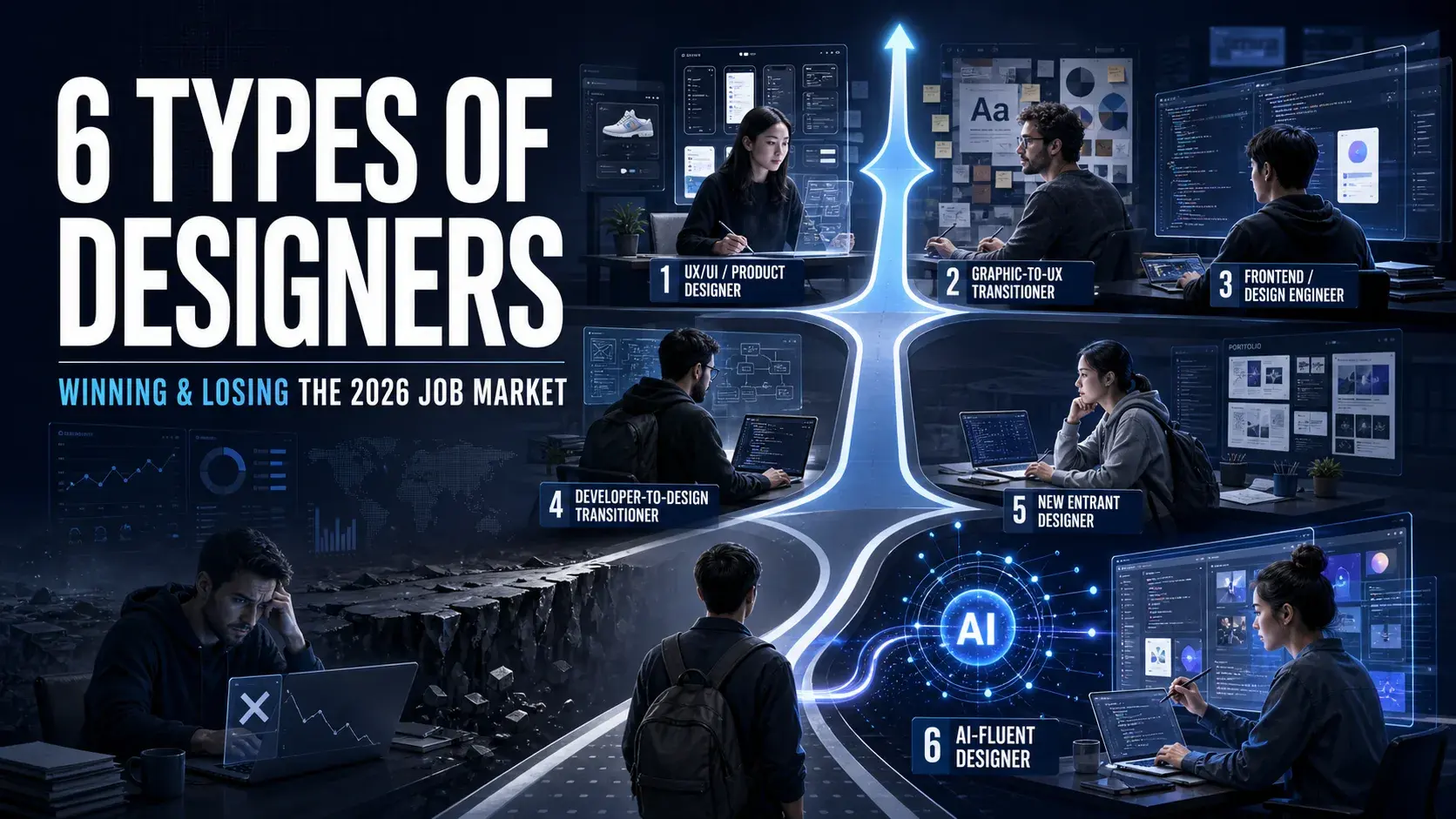
That shift plays out differently depending on where a designer is coming from. A graphic designer, a backend engineer, and someone six months out of a bootcamp are not competing on the same terms, even when they're applying to the same job. Here's how six common starting points actually stack up right now, and what each one needs to do to not get lost in the crowd.
1. UX designer vs. UI designer vs. product designer
This is the comparison every new designer asks about, and it's actually a three-way comparison, not two. Job listings use all three titles somewhat interchangeably, but they aren't the same job, even when one person ends up doing all three.
| UX Designer | UI Designer | Product Designer | |
|---|---|---|---|
| Focus | Does it work? Research, flows, usability | Does it look and feel right? Visual and interaction craft | Should we build it, and does it work as a whole? |
| Core skills | User research, journey mapping, information architecture, usability testing | Visual hierarchy, typography, color, component design, micro-interactions | UX + UI skills, plus product thinking and business judgment |
| Typical output | Flows, wireframes, research findings, usability recommendations | High-fidelity screens, design systems, interaction specs | End-to-end feature ownership, from problem framing to shipped, measured outcome |
| Who's hiring for it | Larger orgs with a research function; some enterprise product teams | Larger orgs, agencies, brand-heavy or visually driven products | Most startups and mid-size product companies: this is the default 2026 title |
A quick way to hold the difference: a UX designer proves the right thing is being built, a UI designer proves it's built well, and a product designer is on the hook for both, plus whether it moved a real business or user metric.
In practice, the split shows up by company size more than by skill:
- At a startup, one person carries the "Product Designer" title and does research, flows, and final pixels themselves, because there's no headcount to specialize.
- At a larger organization, the same three responsibilities often get split across a UX Researcher, a UX Designer, and a UI or Visual Designer, sometimes with a Product Designer sitting above all of them owning the outcome.
Neither structure is more "real." They're different ways of dividing the same total work.
A note on terminology for the rest of this post: most of what follows (the graphic designer, the frontend-leaning designer, the ex-backend engineer, the new entrant, the AI power user) uses "designer" generically, since these are backgrounds, not titles: someone with a frontend or backend history could just as easily land as a UX Designer, a UI Designer, or a Product Designer. The pattern converges on the product designer profile in the broad, startup-default sense: someone expected to reason across research, interaction, visual craft, and business outcome, even if they lean harder into one of those than the others. Where a section is really about a narrower UX-only or UI-only path, that's called out explicitly. If your title is strictly "UX Designer" or "UI Designer" at a larger company, the advice still applies. Just read it as pointing at whichever slice of product design is actually your job.
What to do: Stop introducing yourself by title as if it's a fixed identity. Say what you're strong at (research, interaction, visual craft, business framing) and show it, then demonstrate credible competence in the others so nobody worries you're one-dimensional, or, at a bigger company, mismatched to the specific slice of the role they're hiring for.
2. The graphic designer who moved into UX/UI
The advantage:
- A trained eye. Composition, type, color, hierarchy, visual rhythm: these take years to develop, and AI tools don't hand them to you for free.
- A more finished-looking portfolio on day one than average, which matters in a market where first impressions decide whether a recruiter keeps scrolling.
The risk:
- The instinct to ask "does this look good?" instead of "does this work?" Graphic design is built around a fixed, admired output (a poster, a logo, a brand system). Product design is built around a moving target: real users, in a real context, failing or succeeding at a task.
- Showing a prettier before/after instead of visibly interrogating the decision itself with research and usability reasoning, which is what separates the designers who make this jump well from the ones who don't.
What to do:
- Pair every visual decision in your case studies with a "why" rooted in user behavior, not aesthetic preference.
- Learn to prototype in Figma rather than deliver static comps.
- Show one project where you changed a design because a user struggled with it, not because it looked better.
3. The designer with a frontend background
This is currently one of the strongest positions in the market, whether the resulting title is UI Designer, Product Designer, or something else entirely.
The advantage:
- Understanding component architecture, responsive constraints, and what's actually feasible in code, which gets you taken more seriously by engineering teams.
- Shipping faster, because you design fewer things that have to be renegotiated after handoff. Design-systems fluency, in particular, is one of the specific skills recruiters are calling out as scarce and valuable right now.
The risk:
- Over-indexing on feasibility at the expense of ambition. Years of thinking in components can push you toward "what's easy to build" before you've asked "what does the user actually need."
- Letting that habit quietly narrow the work down to incremental polish instead of real problem-solving.
What to do: Lead with product thinking in interviews and portfolios, not your GitHub. Employers already assume you can code; what they need proof of is that you can also reason about problems, not just implementations. Use the technical fluency as a credibility multiplier in the room, not the headline.
4. The developer who became a designer
Less common, and for that reason more distinctive, if the transition is genuine and not just a resume rebrand. This background can land as a UX Designer, a Product Designer, or an interaction-focused specialist, depending on where the strength shows up most.
The advantage:
- Real strength in systems thinking, edge-case reasoning, and comfort with ambiguity in how data and logic actually behave, which shows up well in complex B2B or workflow-heavy products.
- A natural fit as a translator between design and engineering, sitting at the intersection of creative and technical thinking, something hiring managers increasingly value.
The risk:
- Underdeveloped visual and interaction craft relative to the systems thinking.
- A habit of solving for the system instead of the person using it. A backend mindset optimizes for correctness and completeness; a design mindset optimizes for what a person can understand in three seconds under stress.
What to do: Don't hide the engineering history. It's a differentiator, not a liability. But make sure your case studies show genuine user research and interaction design decisions, not just architecture diagrams relabeled as "process." Get direct, honest feedback from a design lead on your visual craft before you rely on it in interviews.
5. The designer just entering the market
This is the hardest seat in the room right now, and it's worth saying plainly rather than softening it. Some junior listings are drawing 500 to 800 applicants, fewer than 5% of companies say they're open to hiring true entry-level talent, and the roles that do exist increasingly expect mid-level judgment from someone with an entry-level title. AI has taken over a meaningful share of the exploratory, high-volume production work that junior designers used to cut their teeth on, which was also, historically, how they proved themselves.
The advantage nobody expects:
- No bad habits to unlearn.
- Often the fastest to become genuinely fluent with AI tools, because there's no slower workflow to stay attached to.
What to do:
- Do not build a fourth "redesign of a popular app" case study. Recruiters have seen thousands of them, and it currently signals inexperience rather than initiative.
- Pick one real, specific problem (even something small and self-initiated) and go deep enough to show research, iteration, and a defensible decision trail.
- Pair your core design skill with one adjacent skill that makes you harder to replace: frontend basics, data literacy, writing, or genuine AI-tool fluency.
Depth beats breadth at this stage of the market.
6. The designer who works extensively with AI tools
By mid-2026, the shift here has been fast: roughly nine in ten designers now use AI weekly, up sharply from a year earlier, and a large majority say it's improved output quality, not just speed. Designers fluent with AI tools are reportedly shipping several times more iterations and exploring more directions than they were before, and design skill paired with just enough technical fluency now commands a meaningful pay premium over design skill alone.
The advantage:
- Speed and range: exploring five directions in the time it used to take to explore one, by prompting for first-draft layouts, generating moodboards, or scripting repetitive Figma tasks.
- Spending the time saved on judgment instead of production.
The risk: two failure modes, both common:
- Producing a lot of AI-flavored, forgettable work and mistaking volume for progress.
- Leaning on AI output without being able to explain or defend a decision when asked, which is immediately visible to any experienced interviewer.
What to do: Use AI to widen the exploration phase, not to skip the thinking. In interviews and case studies, be explicit and unembarrassed about where AI helped. It reads as current, not as cheating, when the surrounding judgment is clearly yours. Never present AI-generated interface copy, imagery, or flows as final without your own scrutiny; the "make it useful, understandable, and trustworthy" bar that AI-driven products now have to clear is exactly the bar your own use of AI has to clear too.
One more comparison worth adding: the specialist vs. the generalist
This cuts across all five backgrounds above and might be the most decisive split in the current market. The generalist "I do a bit of everything" product designer is the most crowded, least differentiated profile there is right now. The specialist (deep in design systems, deep in research, deep in motion and interaction, deep in a specific vertical like fintech or healthcare, or genuinely fluent in AI-native product design) is who gets remembered.
This doesn't mean abandoning range. It means having a clear, specific answer to "what are you the person to call for?" That kind of clarity is also, not coincidentally, what separates a senior title from a senior designer: a sharpened point of view, not just more years on the job.
A designer with one sharp specialty and competent range around it will consistently beat a designer with even range and no sharp edge.
What actually separates a designer who stands out from one who blends in
Across every background, the same patterns show up on the winning and losing side.
What works:
- Owning a decision trail, not just a deliverable: being able to say why an option was chosen and what was rejected.
- Treating AI as leverage for judgment, not a replacement for it.
- Picking a specific, defensible point of view rather than trying to look competent at everything.
- Showing evidence of impact, even modest and honestly framed, over generic process diagrams.
- Being fluent enough in the adjacent discipline (code, research, business, writing) to collaborate without a translator.
What doesn't work anymore:
- A portfolio built from redesign exercises with no real constraints or stakeholders.
- Design-process slides (double diamond, persona templates) presented as proof of skill rather than evidence of thinking.
- Treating UX and UI as competing identities instead of complementary skills to develop together.
- Using AI output without being able to explain or improve on it.
- Waiting for entry-level roles to be easy again. They're not going back to how they were, and the designers succeeding right now are the ones who stopped waiting and built one deep, real thing instead of ten shallow ones.
Where this goes next
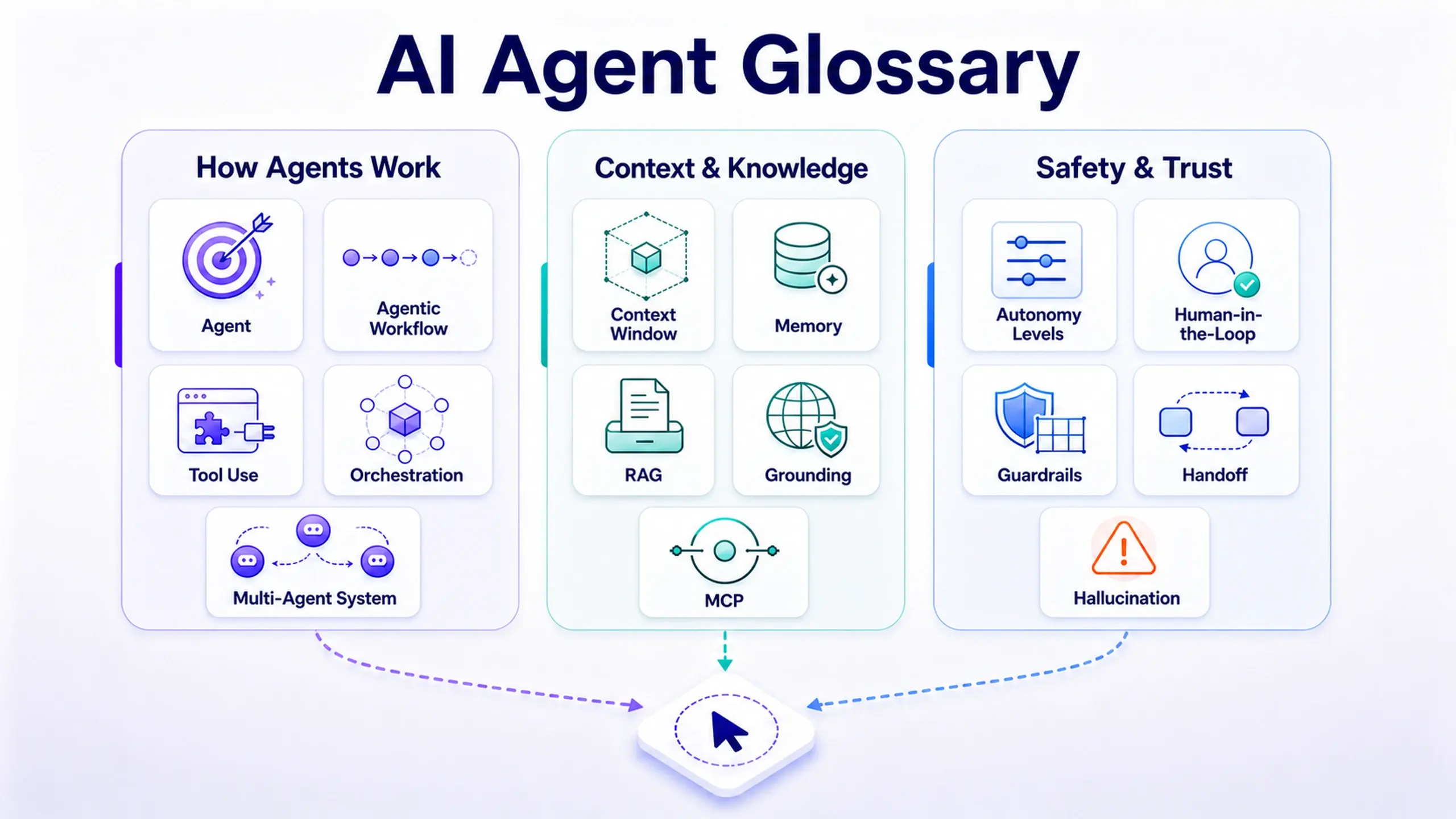
The near-consensus among people tracking this closely is that AI does not remove the need for designers (the World Economic Forum lists UX/UI design among the fastest-growing roles through 2030), but it does keep moving the job upward, away from production and toward orchestration: deciding what an AI-driven experience should do on someone's behalf, and making sure it's understandable and trustworthy when it does it. That orchestration layer already has a name, Agent UX, and a growing vocabulary worth getting fluent in early. The designers who'll be fine are the ones already treating today's AI fluency as practice for that shift, not as a shortcut around learning the fundamentals it's built on.
The market isn't closing. It's asking a sharper question than it used to: not "can you produce a screen," but "can you make a defensible decision, fast, with AI in the room helping you get there." Whichever of the six starting points above you're coming from, that's the bar.
Frequently asked questions
Which title should I use if I do UX, UI, and product work all at once? Use whichever title the market you're applying to actually recognizes, usually "Product Designer" at startups and mid-size companies. Then let your portfolio show the range rather than trying to signal it through the title itself.
Is it too late to break in as a new designer in 2026? No, but the redesign-of-a-popular-app portfolio strategy is over. One deep, self-initiated project with a real decision trail beats ten shallow ones, and pairing design with an adjacent skill (frontend, data, writing, AI fluency) makes a junior candidate meaningfully harder to overlook.
Does using AI tools make my work look less credible in interviews? Not if you can defend every decision in it. Being open about where AI helped reads as current. Being unable to explain or improve on AI output reads as a red flag, regardless of how polished the output looks.
Should I specialize or stay a generalist? Specialize, with competent range around it. A designer with one clear, specific answer to "what are you the person to call for" stands out more reliably in 2026 than a designer with even skill across everything and no sharp edge.
The bar hasn't moved, it's just visible now
Production speed used to hide a lot of thin judgment. AI took that cover away. What's left is the actual question every one of these six paths has to answer: can you decide what's worth building, defend why, and show it worked, with or without AI doing the drafting.
Sources
- CareerFoundry: Product Designer vs. UX Designer
- Coursera: Product Designer vs. UX Designer
- Musemind: UI vs UX vs Product Designer
- UX Design Institute: The UX Job Market in 2026
- UX Design Institute: Will AI Replace UX Designers?
- UX Planet: Why the UX Job Market Is Changing in 2026
- Nielsen Norman Group: State of UX 2026
- The Fountain Institute: What Gets Senior Product Designers Hired in 2026
- TDA: Product Design Recruitment in 2026
- Devlin Peck: AI in Design 2026
- UX Playbook: UX Designer Job Market Reality in 2026
- Medium: Entry Level UI/UX Jobs in 2026 Are Disappearing
- Confetti Design: Why Are Graphic Designers Transitioning to UI/UX
- Medium: From Software Engineer to Product Designer
- Medium: The Future of Interaction, UX, and CX Design Jobs
This post was edited with AI assistance for clarity and formatting.

Sanjay Shrestha
Senior Product Designer · CUA™ Certified
15+ years designing enterprise SaaS, B2B, and government digital products. Currently at Decisions.
Keep Reading